Showing posts with label vision. Show all posts

Monday, 30 April 2012

Milly: Polarization Paradise


I've not been the most active of writers on this blog of late but, fear not, I'm going to write another series of posts as I blog/blather from the field.
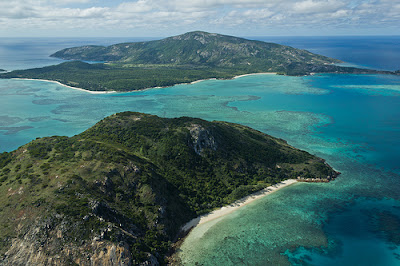
Lizard Island, Australia. Photo: Michael Bok.
In just under a month from now, my lab and I (Ecology of Vision Group) will be flying to Australia, Lizard Island, on a mission to unveil more secrets about the vision of marine animals. You may be wondering why it is necessary to travel across the world to do this. Well, aside from the fact that scientific success increases significantly when in an idyllic location (obviously), we need access to Australia's diverse range of reef dwelling beasties, including the charming octopus and the not so charming mantis shrimp, more likely to rip your hand off than to shake it.

A mantis shrimp (stomatopod).
Photo: web.
Our team have collected all of the gear we will be needing for experiments: LCD screens, perspex tubes, lightbulbs, cameras, 3D glasses and milk. Now, it may sound like we are planning to watch a film, but actually we are going to do some serious and exciting science.

The word that binds our research together is polarization. If my colleagues and I were the mince, polarization would be the egg that binds us together forming the burger (?!) that is our group. Slightly off the beaten (egg) track.

Serious science time:


What is polarization?
Unpolarized light coming from a light source is oscillating at all
possible angles in that plane, however, when it is passed through a
filter (polaroid) it becomes polarized, oscillating only at one angle.
When applied to light, polarization means the direction that the light is oscillating in. If you imagine that you are holding a rope and you shake it up and down, waves form, travelling down its length. You can shake the rope from side to side, or also swirl it round forming a rotating pattern that also travels along the rope. This same idea can be applied to light as it too oscillates as it is travelling along as a wave. Just like the wavelength of light can inform an animal of the colour of something it can see, polarization can also provide additional information as light bounces off different structures or is scattered by particles.

How can an animal detect polarized light? 
We, as humans, know that polarized light exists around us, but unfortunately, without polaroid filters, we cannot see it. Unless of course you are one of the lucky few who have deliberately tried to view strong sources of polarized light such as LCD monitor outputs and are now cursed, forever having a strange yellow bow tie shape appear randomly on the desktop. It's called Haidinger's brush if you fancy having a go yourself. To detect polarized light oscillating at one angle, your photoreceptors must be aligned at that same angle, to absorb the maximum amount of light. If your photoreceptor is, say, 90degrees out compared to the polarized light, then it's not going to absorb very efficiently. This sort of arrangement of photoreceptors where one lies at one angle and a second, connected photoreceptor is lined up perpendicular to it, is very common in invertebrates and is the basis for their polarization vision. Simply put, it allows them to compare the outputs of these two receptors and figure out what angle the light is oscillating at.

Why is polarization vision useful?
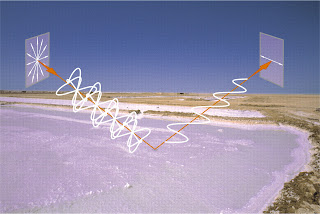
Unpolarized light bouncing off the surface of the
water becoming polarized horizontally.
Photo: Wehner (2001).
At first it might sound like polarization vision could be disadvantageous, since you have the potential to lose information every time polarized light hits your receptors at the wrong angle. What it does do, however, is convey valuable information. When light bounces off a shiny surface, such as water, much of the reflected light becomes horizontally polarized (oscillating at the same angle as the water's surface). If the light hits the water at Brewster's Angle, then all of the light is horizontally polarized. Now, imagine that you are a water-seeking insect where the survival of your species depends on you reaching water to mate and lay your eggs. Some strong selection pressures there. If you have receptors aligned horizontally and pointing down towards the ground, you have a perfect water detecting device. This is a common feature of water-seeking insects. Unfortunately, lots of man-made surfaces are shiny so if you have ever wondered why you find dead beetles and mayflies on the highly reflective bonnet of your car...now you know. Polarization vision isn't just useful for this one task, light is also polarized as it travels through scattering media such as water, or the atmosphere. As the light scatters it becomes polarized at an angle depending on the incident light. If this is happening millions of times in the sky as the light travels towards the Earth, a predictable pattern is formed which acts as a map to navigation and orientation in bees, beetles and other insects where the landscape is complex, moving and changing or devoid of any useful visual landmarks on the ground. The same applies underwater.


Invertebrates such as insects, crabs and cuttlefish have polarization
sensitive cells in the eye consisting of perpendicularly oriented
light absorbing microvilli. You can see the two orientations in the
TEM image of dragonfly photoreceptors above.
Photo: Meyer and Labhart (1993)

I still haven't got to the bit where I explain what we are doing in Australia. I think that is quite enough for one post, time for a cup of tea.


Friday, 2 September 2011

Julio: Student Experience: Or Why Study Mathematics at the University of Bristol?


My intention in this post is to comment and present some of my experiences and my own visions of the Department of Mathematics of the University of Bristol.

When I arrived at the Department of Mathematics here in Bristol for the first time, I was very well received by the staff and especially by my supervisors Jon Keating and Nina Snaith, they present me the department and gave me a warm welcome.

The math department in Bristol definitely is worldwide
known, and with leaders in various areas of research. For example in my case, I work with number theory and the department have researchers at the highest level in number theory and related areas. I'm lucky to be part of the number theory and quantum chaos groups here in Bristol.

But the areas of research here in the department of Bristol not only restrict to the number theory and if you take a look on the website about research groups in the department you may notice that there is research in several areas of mathematics such that Pure mathematics (such as research in analysis, partial differential equations, dynamical systems, algebra and others), Applied Mathematics (random matrix theory, quantum chaos, statistical mechanics, quantum information and others) and Statistics (Applied Probability, Monte Carlo, behavioural biology and others)
. So research in mathematics at the University of Bristol is vivid and very varied.

The courses offered are varied and change each year ranging from undergraduate level units up to advanced graduate courses. The Postgraduate courses and the department of mathematics is part of the TCC along with other universities (University of Bath, Imperial College, University of Oxford and the University of Warwick) which offer advanced courses in specific mathematical subjects. I can say that these courses are very useful for the mathematical training of anyone involved in any area of ​​mathematics.

I am enjoying my course and have been learning many new things every day. The Mathematics Department is very well structured with good rooms, seminar rooms, teaching rooms, computer lab rooms and many excellent lecturers. The professors here are very friendly and always ready to help. Studying in Bristol has been a priceless experience for me and I'm sure it will enormously contribute to my career as a mathematician and to my personal life.

The University of Bristol is very well located in the city of Bristol and this is amazing, since everything is quite close to the University.
Bristol is a very nice city, probably one of the best places invUK. It's got all the good things the big city has, and yet it is a calm and safe place and is close from London. The city has good train and coach stations and even an airport where you can not catch only direct flights to other cities in the UK, but also to many other cities.

I highly recommend to my friends in Brazil to apply and come to study here, I guarantee you will be a unique experience and very rewarding academically, professionally and personally.

Tuesday, 26 July 2011

Milly: Ugly fish

Stomiid. Image: Camilla Sharkey and Julian Partridge
Milly: Ugly Fish pt 2
Milly: Ugly Fish pt 3
Milly: Ugly Fish pt 4
Milly: Ugly Fish pt 5
Milly: Ugly Fish Pt 6
Milly: Ugly Fish Pt 7

When asked about my summer holiday plans recently, I informed my friend that I would be spending a month off the coast of the UK on a months fishing trip. She laughed; I wasn't joking. Come August I'll be up to my ears in gelatinous, benthic fish brought up from thousands of meters and rather alarmingly I've been purchased full body overalls due to the "repulsive stench" of the fish that "never leaves the fabric". I'll be aboard the RSS James Cook for a month, so to stave off insanity I'm planning to blog from the ship to keeping you up to date with the latest discoveries. It seems to be a little known fact that members of the Bristol Biology department study deep sea fish and so I thought it best to bring a little of the research into the lime light.

Dr Nick Roberts, part of a team of Bristol vision scientists, has gathered together a group to investigate colour and light in nature. As part of this, a new post doc, Dr Juliette McGregor, will be looking at the effect of pressure on photoreceptors. The pressure exerted on deep sea fish is enough to alter the protein structure and this includes that of visual pigments so in August, Juliette and I will be collecting deep sea fish retinal tissue which will be used to examine their spectral properties under pressure (whilst trying not to be sick onto the specimens as we dissect stinky fish...on a rolling boat...in the dark).
Another ongoing project has been looking at the eyes of Malacosteus niger (image below) the stoplight loosejaw, a fish with red eyes, gaping mouth and a light organ underneath each eye that emits red light.
Stoplight loosejaw, Malacosteus niger
Most deep sea animals can only detect blue light (a colour common at depth as many animals produce blue bioluminescence) so by producing red light, M.niger can hunt prey or communicate with other individuals without fear of detection! Now what is particularly amazing about these creatures is what's found in their red eyes. In order to detect longwave red light, they use chlorophyll as a photosensitiser. But that's in plants I hear you shriek! Well, even stranger than that, the visual properties of the pigment is very similar to that found in small crustaceans it eats (see paper). So does M.niger use chlorophyll it obtains from its diet to alter the wavelength of light it can see?! We don't have the full story yet so watch this space...
Dolichopteryx longipes photographed from above
Another amazing discovery was made during a past research cruise by Professor Jochen Wagner (University of Tubingen), Prof. Ron Douglas (City University London) and Prof. Julian Patridge from Bristol. Whilst midwater trawling they discovered a live specimen of Dolichopteryx longipes (image right). Previously only one preserved fish was available for studying this unique species, the only vertebrate found to form images using a mirror instead of a lens which reflects light onto a second retina.

These fish appear to have four eyes and although there are just two, each is separated into two parts, one looking upwards and the other down. This allows D.longipes to detect silhouettes of animals above it, but also detect bioluminescence produced by animals below. For more info on this fascinating fish see this news article or paper.

I think that's quite enough biology for now, but I hope I leave you with a better idea of what strange things are going on in the Bristol University biological department and keep your eyes peeled for posts in August from the Porcupine Abyssal Plain, eek!