Showing posts with label bristol university. Show all posts

Monday, 30 April 2012

Milly: Polarization Paradise


I've not been the most active of writers on this blog of late but, fear not, I'm going to write another series of posts as I blog/blather from the field.
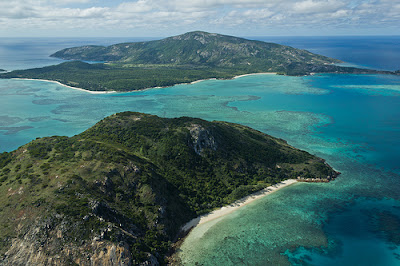
Lizard Island, Australia. Photo: Michael Bok.
In just under a month from now, my lab and I (Ecology of Vision Group) will be flying to Australia, Lizard Island, on a mission to unveil more secrets about the vision of marine animals. You may be wondering why it is necessary to travel across the world to do this. Well, aside from the fact that scientific success increases significantly when in an idyllic location (obviously), we need access to Australia's diverse range of reef dwelling beasties, including the charming octopus and the not so charming mantis shrimp, more likely to rip your hand off than to shake it.

A mantis shrimp (stomatopod).
Photo: web.
Our team have collected all of the gear we will be needing for experiments: LCD screens, perspex tubes, lightbulbs, cameras, 3D glasses and milk. Now, it may sound like we are planning to watch a film, but actually we are going to do some serious and exciting science.

The word that binds our research together is polarization. If my colleagues and I were the mince, polarization would be the egg that binds us together forming the burger (?!) that is our group. Slightly off the beaten (egg) track.

Serious science time:


What is polarization?
Unpolarized light coming from a light source is oscillating at all
possible angles in that plane, however, when it is passed through a
filter (polaroid) it becomes polarized, oscillating only at one angle.
When applied to light, polarization means the direction that the light is oscillating in. If you imagine that you are holding a rope and you shake it up and down, waves form, travelling down its length. You can shake the rope from side to side, or also swirl it round forming a rotating pattern that also travels along the rope. This same idea can be applied to light as it too oscillates as it is travelling along as a wave. Just like the wavelength of light can inform an animal of the colour of something it can see, polarization can also provide additional information as light bounces off different structures or is scattered by particles.

How can an animal detect polarized light? 
We, as humans, know that polarized light exists around us, but unfortunately, without polaroid filters, we cannot see it. Unless of course you are one of the lucky few who have deliberately tried to view strong sources of polarized light such as LCD monitor outputs and are now cursed, forever having a strange yellow bow tie shape appear randomly on the desktop. It's called Haidinger's brush if you fancy having a go yourself. To detect polarized light oscillating at one angle, your photoreceptors must be aligned at that same angle, to absorb the maximum amount of light. If your photoreceptor is, say, 90degrees out compared to the polarized light, then it's not going to absorb very efficiently. This sort of arrangement of photoreceptors where one lies at one angle and a second, connected photoreceptor is lined up perpendicular to it, is very common in invertebrates and is the basis for their polarization vision. Simply put, it allows them to compare the outputs of these two receptors and figure out what angle the light is oscillating at.

Why is polarization vision useful?
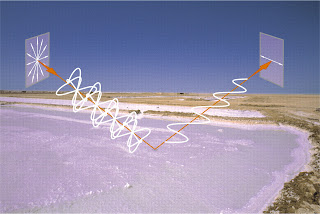
Unpolarized light bouncing off the surface of the
water becoming polarized horizontally.
Photo: Wehner (2001).
At first it might sound like polarization vision could be disadvantageous, since you have the potential to lose information every time polarized light hits your receptors at the wrong angle. What it does do, however, is convey valuable information. When light bounces off a shiny surface, such as water, much of the reflected light becomes horizontally polarized (oscillating at the same angle as the water's surface). If the light hits the water at Brewster's Angle, then all of the light is horizontally polarized. Now, imagine that you are a water-seeking insect where the survival of your species depends on you reaching water to mate and lay your eggs. Some strong selection pressures there. If you have receptors aligned horizontally and pointing down towards the ground, you have a perfect water detecting device. This is a common feature of water-seeking insects. Unfortunately, lots of man-made surfaces are shiny so if you have ever wondered why you find dead beetles and mayflies on the highly reflective bonnet of your car...now you know. Polarization vision isn't just useful for this one task, light is also polarized as it travels through scattering media such as water, or the atmosphere. As the light scatters it becomes polarized at an angle depending on the incident light. If this is happening millions of times in the sky as the light travels towards the Earth, a predictable pattern is formed which acts as a map to navigation and orientation in bees, beetles and other insects where the landscape is complex, moving and changing or devoid of any useful visual landmarks on the ground. The same applies underwater.


Invertebrates such as insects, crabs and cuttlefish have polarization
sensitive cells in the eye consisting of perpendicularly oriented
light absorbing microvilli. You can see the two orientations in the
TEM image of dragonfly photoreceptors above.
Photo: Meyer and Labhart (1993)

I still haven't got to the bit where I explain what we are doing in Australia. I think that is quite enough for one post, time for a cup of tea.


Tuesday, 10 January 2012

Milly: Make some cheese!


I really like cheese.

After some cheese based internet cruising I realised that I could realistically make some myself and so I set forth on a mission to curdle myself a brick of paneer. Since it is easy, cheap and fun (for those who don't get grossed out by things that look like vomit) I have decided to share with you, the joy of curdling.

SCIENCE BIT

Curdling. That thing you accidentally do during cooking when you add cold milk to hot things or when you leave milk in the fridge for so long that it gets a little chunky. Curdling milk is a necessary first step to make all cheeses. It occurs because, on addition of acid (lemon juice, vinegar or from the product of bacteria), the milk coagulates, no longer existing as a nice stable emulsion anymore but separating out into curds (solid) and whey (liquid). When you mix oil and water, an emulsion, eventually the oil will rise to the surface; this is the same with curdling as the more buoyant curds will float up and sit atop the watery whey, hoorwhey! For cheeses that wish to be hard, rennet must be added (extract of calf stomach), forming more cohesive curdling action via the action of enzymes. These cheeses go on to be inoculated with mould and what not but here I will simply demonstrate curdling cow's milk, with lemon juice, to form paneer, a simple cheese used in indian cookery (bit like solidified cottage cheese).

COOKING BIT

Step 1: Heat up a large amount of full fat milk (and only full fat). I used 4 pints. Use a medium heat and keep stirring or it may burn on the bottom (if this happens don't scrape it off, this will make things worse). At this stage you can add herbs/spices if you fancy.


Step 2: Once the milk is properly boiling (before this happens the milk might balloon into a giant dairy cloud so be ready to turn the heat down) add about half a lemon's worth of juice and stir gently. It should start to look disgusting, as shown in the picture. It should progress through the vomit stage (below) and start to look more lumpy, like overcooked scrambled eggs. If this doesn't happen add more lemon juice (shouldn't need more than 1 lemon if using 4 pints). If desired curdling has not been achieved, you may need to start again (this can happen if the milk is not hot enough).


Step 3: Pour the appealing mixture through a piece of muslin (try Kitchens, Whiteladies Road) sat in a colander and give it a rinse with cold water until the mixture is cool enough to handle. Give it a good squeeze to get out excess whey, wrap it up in the cloth tightly and sit a weight on top (big pan with tins in should do it).


Step 4: After about an hour the paneer should be a relatively solid block but it will probably still be quite crumbly.


Step 5: Cook the paneer! I fried mine in some oil to stop it from falling apart when I added it to a curry.


If you fancy a cheap meat alternative or something to make a lovely curry out of have a bash. I like cheese and I hope you do too.

Tuesday, 22 November 2011

Sir Paul Nurse and Poetry

Photo: Royal Society
There were two great events held here in Bristol last night, one at the University and one at the Bristol Old Vic, and I was hoping against hope that I would find a connection between them to make this blog post flow! And... what do you know? I did. The first was Sir Paul Nurse, president of the Royal Society, Nobel Prize winner, geneticist, president of Rockefeller University New York... all-round very very interesting scientist and excellent talker-about-science! He was giving the Sir Anthony Epstein lecture at the Wills Tower, in the largest, cathedral-like space, which was packed to the rafters... His topic was "Great Ideas in Biology" and he was quick to point out that these weren't THE great ideas in biology but his pick of great ideas... although he felt that most people would agree on 4 out of the 5.

So, what were his great ideas? Well: The Cell, The Gene, Evolution by Natural Selection, Life as Chemistry (and Physics) and the fifth, possibly contentious one, Biology as an Organized System, by which he meant looking at the biological networks and how they are structured, looking at the flow of "information", at the system as an information carrier.

It was all fascinating stuff, some of which I already knew a bit of, but always good to be reminded what a chromosome is, for example... with some great slides and historical perspective! I was then heading to a poetry event, so, I hear you ask, how are the two connected?? Well, it was at Great Idea Number 3, which you would assume centred around one Charles Darwin. But no, in fact Sir Paul wanted to focus on Charles' grandad, Erasmus, who was the first to talk about evolution (Charles later supplied the vast quantities of data to prove it). Not only that, apparently Erasmus - who was a colourful figure, so large that he cut an oval out of his dining table so he might sit rather nearer to his supper, and fathered 14 children - was a poet, at one time "one of the best known poets in England"! And not only that, he wrote much of his scientific reports in blank verse! (See Jenny Uglow on Erasmus Darwin's poetry in The Guardian). The Poetry Foundation gives us his poem, The Botanic Garden, and here is an excerpt:
 “You taught mysterious Bacon to explore
Metallic veins, and part the dross from ore;
With sylvan coal in whirling mills combine
The crystal’d nitre, and the sulphurous mine;
Through wiry nets the black diffusion strain,
And close an airy ocean in a grain.—
Pent in dark chambers of cylindric brass,
Slumbers in grim repose the sooty mass;
Lit by the brilliant spark, from grain to grain
Runs the quick fire along the kindling train;
On the pain’d ear-drum bursts the sudden crash
Starts the red-flame, and death pursues the flash.—
Fear’s feeble hand directs the fiery darts,
And strength and courage yield to chemic arts;
Guilt with pale brow the mimic thunder owns,
And tyrants tremble on their blood-stain’d thrones.

Stirring stuff! Now the poets I went to see after this lecture, Luke Kennard and Tom Philips,  did not deal directly with biology but I feel that Erasmus D would have enjoyed the evening, which moved from a searing critique/love poem about Portishead to a tale of the Murderer being taken for a haircut. I was immensely impressed by the whole event, organised monthly by Word of Mouth -  highly recommended if you are in the vicinity!

So, an evening of poetry, biology and biological poetry, what more could I have wanted?

Friday, 11 November 2011

James:A Nuclear Renaissance


Nuclear has had some what of a bad reputation of late, to such an extent that up until the white paper in 2009 there was to be no British nuclear future. As a man who grew up from the age of 4 saying 'I want to be a nuclear physicist' this was very worrying. However, now the tides have turned as realisation has come that, for whatever reason you chose, energy generation can not last on fossil fuels alone and we want power not just when the wind blows and the sun shines. So sorry folks but we need nuclear. Now I personally was very proud to be part of the launch of the new Nuclear Research Centre which will be mainly hosted by Bristol and Oxford universities supported by industry. This is, as the Minister of State Charles Hendry put it is 'the begin of a nuclear renaissance'. Which was highlighted by the demographic in the room as 'networking' began over sandwiches and tea. Britain has been out of the nuclear game too long, so there was a generation gap between those heading and steering the centre and us new guys looking to do the 'on the ground' research. It was alluded to during one of the opening speeches that this is a long term set of goals being created so they aren't for those setting the questions but more the eager minds of the new nuclear research generation coming through. Although I may look to be coming from a rather one eyed perspective I think this is a great thing and the first of many steps in the right direction which I hope to be a part of. Another key aspect that will set the NRC apart is that the research will be split into three main areas; first advanced research into generation 4 fission reactors and generation 1 fusion, secondly applied research looking to make the most of the energy produced and finally and possibly most importantly 'Nuclear Futures' a group dedicated to the social and environmental issues. So this will see working together as one not just the physicists, chemists, engineers but also those from the social sciences. I believe this is a good thing, and Tuesday could turn out to be a momentous occasion, not only for the country but also for Bristol University going forward to be the leader in yet another field.

Tuesday, 25 October 2011

Learn more about public engagement opportunities

(Posted on behalf of Ed Drewitt, School of Earth Sciences)

Hi everyone,

With many of the departments in the University involved with public engagement, there will be various opportunities for you as staff or postgrads to get more involved both with these and other volunteer experiences. Being involved with the outreach work is a great chance for you to increase your confidence with delivering to various different audiences (from 5 year olds to 14 year olds) and to help provide you with the experience to confidently include public engagement activities in your future research bids.

 On Tuesday 1st November we welcome Nicholas Garrick (Director of Lighting Up Learning) and Claire Dimond (STEM- see below) who will give 4 workshops throughout the day (it'll be the same workshop repeated) which will give additional advice and skills relating to delivering high quality and effective workshops in schools. These will be held in the Wills Memorial Building.

 It is a chance to learn about where schools are at, changes in the school system since we were at school (even if it was a few years ago) and tips on good practice when doing activities and workshops. Timings and rooms are as follows:
School of Earth Sciences, Wills Memorial Building  
9am - 10am G25
12pm - 1pm G27
1.15pm - 2.15pm OCC (Old Council Chamber) -on the corridor above G25 and opposite the student common room
 2.30pm - 3.30pm OCC (Old Council Chamber) -on the corridor above G25 and opposite the student common room 

To help deliver workshops we also encourage you to sign up as a STEM (Science, Technology, Engineering and Maths) Ambassador: We recommend you do this before the 1st November so you can show document to Claire Dimond on the day. As part of your commitment with being involved with schools and families, we ask that you join up as a STEM Ambassador. STEM Ambassadors are people from industry and universities who visit schools to give talks or workshops relating to STEM subjects. Alongside the workshops we offer you'll get regular newsletters about other things you can do in schools locally.

You'll get CRB (Criminal Records Bureau) checked for free and be covered under insurance for any school visits. For more information and to sign up as a STEM Ambassador click here.

Looking forward to see you next week.
 Best wishes
 Ed

 See our new website bristoldinosaur.com and why not like us on our Facebook page

Tuesday, 26 July 2011

Milly: Ugly fish

Stomiid. Image: Camilla Sharkey and Julian Partridge
Milly: Ugly Fish pt 2
Milly: Ugly Fish pt 3
Milly: Ugly Fish pt 4
Milly: Ugly Fish pt 5
Milly: Ugly Fish Pt 6
Milly: Ugly Fish Pt 7

When asked about my summer holiday plans recently, I informed my friend that I would be spending a month off the coast of the UK on a months fishing trip. She laughed; I wasn't joking. Come August I'll be up to my ears in gelatinous, benthic fish brought up from thousands of meters and rather alarmingly I've been purchased full body overalls due to the "repulsive stench" of the fish that "never leaves the fabric". I'll be aboard the RSS James Cook for a month, so to stave off insanity I'm planning to blog from the ship to keeping you up to date with the latest discoveries. It seems to be a little known fact that members of the Bristol Biology department study deep sea fish and so I thought it best to bring a little of the research into the lime light.

Dr Nick Roberts, part of a team of Bristol vision scientists, has gathered together a group to investigate colour and light in nature. As part of this, a new post doc, Dr Juliette McGregor, will be looking at the effect of pressure on photoreceptors. The pressure exerted on deep sea fish is enough to alter the protein structure and this includes that of visual pigments so in August, Juliette and I will be collecting deep sea fish retinal tissue which will be used to examine their spectral properties under pressure (whilst trying not to be sick onto the specimens as we dissect stinky fish...on a rolling boat...in the dark).
Another ongoing project has been looking at the eyes of Malacosteus niger (image below) the stoplight loosejaw, a fish with red eyes, gaping mouth and a light organ underneath each eye that emits red light.
Stoplight loosejaw, Malacosteus niger
Most deep sea animals can only detect blue light (a colour common at depth as many animals produce blue bioluminescence) so by producing red light, M.niger can hunt prey or communicate with other individuals without fear of detection! Now what is particularly amazing about these creatures is what's found in their red eyes. In order to detect longwave red light, they use chlorophyll as a photosensitiser. But that's in plants I hear you shriek! Well, even stranger than that, the visual properties of the pigment is very similar to that found in small crustaceans it eats (see paper). So does M.niger use chlorophyll it obtains from its diet to alter the wavelength of light it can see?! We don't have the full story yet so watch this space...
Dolichopteryx longipes photographed from above
Another amazing discovery was made during a past research cruise by Professor Jochen Wagner (University of Tubingen), Prof. Ron Douglas (City University London) and Prof. Julian Patridge from Bristol. Whilst midwater trawling they discovered a live specimen of Dolichopteryx longipes (image right). Previously only one preserved fish was available for studying this unique species, the only vertebrate found to form images using a mirror instead of a lens which reflects light onto a second retina.

These fish appear to have four eyes and although there are just two, each is separated into two parts, one looking upwards and the other down. This allows D.longipes to detect silhouettes of animals above it, but also detect bioluminescence produced by animals below. For more info on this fascinating fish see this news article or paper.

I think that's quite enough biology for now, but I hope I leave you with a better idea of what strange things are going on in the Bristol University biological department and keep your eyes peeled for posts in August from the Porcupine Abyssal Plain, eek!

Thursday, 21 July 2011

Julio: Conference for Mathematicians.

Here's an event that will take place here in the Department of Mathematics at the University of Bristol on September 08th:

Heilbronn Annual Conference 2011.


Between 08 September 2011 to 09 September 2011 the Department of Mathematics together with the Heilbronn Institute will be hosting the 2011 Heilbronn Annual Conference. Where a series of distinguished mathematicians have been invited to present lectures on a number of research themes.

Starts: lunchtime on 08 September 2011
Finishes: 09 September 2011
Venue: School of Chemistry, Lecture Theatre 2 & East Foyer, University of Bristol.


If you have any interest in attending this event you can get more information as well as speakers and registration form at the meeting website for this event.

Tuesday, 19 July 2011

Milly: Waste not. Want not.


Nuclear waste. It's extremely dangerous. How do you get rid of it? Short answer is, you can't. Have you ever wondered what could happen if future generations discovered our nuclear waste? Probably not, I certainly hadn't until I watched this documentary, 'Into Eternity'. Imagine that in thousands of years, we no longer understand the dangers of nuclear waste, or even what it is. Imagine that we discover the place where it is hidden. How do we emphasise how catastrophic exposing nuclear waste could be for humans and all life on earth? Do we even speak the same language and do symbols still have the same meaning? This stunning and thought-provoking film is definitely worth a watch if not only to marvel at the magnitude of Onkalo, Finland's nuclear waste repository. Pretty scary stuff.

See James' post for info on nuclear radiation.


Monday, 25 April 2011

James: An Interview with Dr Tom Scott

When I was asked to interview someone from my research group I knew instantly the man to go to. Dr Thomas B Scott, PhD, MSci, Director of the Interface Analysis Centre (IAC) and Honorary Lecturer in Earth Sciences. The reason for this is I thought Tom’s mentality would be perfect for it, coupled with the fact I myself have found want to ask him questions about himself as he has risen to success early in life, something any aspiring academic would want to emulate.

Tom did his PhD here at Bristol in environmental geochemistry and mobility of uranium and its potential for uptake by iron and iron-bearing minerals, which he loved to such a degree that he stayed to do research, which lead into his current area of research: Nuclear materials - safe storage, environmental transport, structures and fundamental properties.

When asked why did you come into, and stay in, academia his response was: “I like the idea that any day you could come into the lab, run an experiment and find out something new that nobody has ever seen before. I'd also like to leave a positive mark on humanity by contributing something which helps make a better world”. I feel this shows the kid-like excitement of discovery and the hope to do good in the world. However, with being director and honorary lecturer Tom doesn’t just get to do research, as he pointed out himself, he misses working in the lab everyday (even if it is just to stop us making a mess). One of the extra things that Tom really enjoys about his job is getting new grant funding for the IAC, indeed in his own words "I like winning!" and "winning" grants at times has given Tom so much glee that he has run round the department for a round of hi-fives.

When asked what a typical day was in the life of Dr Tom Scott, the response surprised me somewhat:

Get up at 6.40am; breakfast; help get little ones fed; get dressed; help get little ones dressed; get to work by 8.45am after dropping off little ones at nursery; check emails; deal with urgent issues;  planned phone calls; meetings; 1-2 hours personal research work; 1 hour (or more) of student work and/or issues; Have lunch in office about 4pm; pick up little one by 5.15pm; get home and have dinner; get kids in the bath and then bed by 7.15pm; 8pm onwards check emails and continue working for a few hours; go to bed knackered and hope the little ones sleep through.

The things that stuck out to me most where the time he has to get up in the morning coupled with the time until lunch, add to that continuing to work after getting his children to bed. It gives me more respect for him, and I think in future will stop me being so miffed when I can not find him to help me with my own ends. I get up after him and never do work after I have left the office.

One of my more benign questions during the interview was: Do you work to music? Some people are very different, for instance I have music on constantly where as other require complete silence. Tom it turns out tends towards classical music most notably Ludovico Einaudi, an Italian composer and pianist. Little known fact, as well as being known in classical circles Ludovico has also done some music scores for films mostly in Italian but also ‘This is England’.

When asked about time out of the office at conferences and whether he thought them productive, he used the example of a conference in Slovakia he had just been to. To make the most of his time there he went with a “game plan":

1) Deliver a kick-ass talk that showed the AWE and all others attending that  in Bristol we're doing some fantastic science and have some fantastic facilities.
2) Then capitalise on the interest generated by my talk to cultivate international research links and collaborations with other senior researchers. Down the road this might lead to FP7 or similar funding.
3) Spend time with guys from the AWE, to strengthen relationships and engage in future research planning. This is VERY important.
4) Watch talks to improve my general background understanding in different areas of actinide/nuclear science. It’s also a prime opportunity to spot good PhD students from Europe that are close to finishing. I can then target them to bring them to Bristol on Marie Curie fellowships.
5) Have a few full nights of sleep.

This is quite different to the "jolly" I thought they were going on off to Slovakia, I was expecting it to be more like a holiday but on expenses.

Finally I wrapped up the interview by asking what Tom’s short and long term goals were. To which the response was some simple things like "go skiing" and "teach the kids to play tennis". Some personal challenges: "complete the 3-peaks and run another half marathon". Then there were loftier goals which are "grow the IAC; become a Professor; start and own a successful company; retire by 55; keep doing research for fun."

Posted by James.

Tuesday, 12 April 2011

Welcome to the new bloggers!

The first Science Faculty blogging course has been running for several weeks now and it's time that the new bloggers made their first appearance here! So, here are excerpts from the first exercise I set them for homework, a blog "inspired by" our first session. Do leave a comment, give them some encouragement!

My first blog meeting ever
As I was walking back home, I was thinking a lot about my first blogging experience. Why do I want to learn how to blog? What do I hope to gain? Truth be told, I’ve never really paid much attention to blogs. I have a Facebook account and a page so I can promote my research, but I never thought about blogging. Even worse, I had no idea that the Science faculty had one (yes, I am deeply ashamed of my ignorance).
Then again, there are so many things I don’t know. Ever since I moved to Bristol from Athens, every day is a new experience. Sometimes I feel like I am a toddler exploring the world around me. My limited capacity processor (aka brain) tries to process the stimuli, and though it is not always successful, I still make an effort anyway. Like in the dream, I keep trying to dial the right number or wake up trying.
So, back to the original question: to blog or not to blog? Would the world be interested in my thoughts? Would I care if they didn’t? How would I feel if people didn’t like my way of thinking? Would I get upset?
I have no idea whatsoever. There is only one-way to find out. I think I should blog. I should just say what I think and see what happens.
Hello world !!! My name is Ypapanti, I am Greek (thus the I-don’t-think-I-can-pronounce-this name) and you can call me Papi.
Ypapanti Chochorelou, 3rd year Psychology undergraduate. See the Science Faculty portrait of her here.

Blogging Everywhere
Last Tuesday was the kick off for the first Science Faculty Blogging Course, and to be honest, I was skeptical about the idea of a blogging course, because, I've always had the idea that write a blog should be very intuitive, not too sophisticated, that you don’t need to have previous instruction - basically, such a friendly coffee talk! However, it was totally cool, because somehow the blogging experience became real with people with different background and interests. So, I would like to share my experience reading and writing blog stuff using my iPod and some exciting apps...
...In my experience, I will always prefer to edit and publish entries on a PC or laptop, but sometimes the ideas don’t pop up in the right moment, for those kind of unexpected moments, I use a text editor called Plain Text. As the app of the same title, it’s a simple editor like the default notes app, with the extra features that allows you to create and organize folders and sync everything with Dropbox. Nevertheless, the minimalist paper-like user interface makes the experience of writing and creating something simple and elegant, without distractions (nasty ads), only you and an entire world to be walked and discovered.
Well, I’m at the end of this first entry, so the only thing that I have to say is that almost every app is good. Maybe these that I’ve reviewed are the more boring, complex, least reliable and awful in the whole world, but it all relies on the experience of each user. Which ones are the best for you?
Angel Sanchez, PhD student, Chemistry.

My first blog post
Does the following paragraph grab most audiences?
“A significant seismological event of magnitude 9.1-9.3 has ruptured the fault boundary between the Indo-Australian and southeastern Eurasian plates on the 26 December 2004. Rapid fault slip of up to 15 meters occurred in the southern portion of the belt but to the north the slip was much smaller.”
I’ve just described the technical details of the 2004 Boxing Day Sumatra earthquake. But I definitely haven’t engaged you (unless you are a seismologist). Simply put, this was an earth-shattering event only surpassed in magnitude by the recent Japanese earthquake. There was so much energy that the Earth literally tore apart - the ocean floor ripped apart for over 1,300 km. That’s roughly the distance of Edinburgh to Prague. Hopefully that’s a bit more readable.

(I hope you’re still reading, I’m now trying to be a little less science-y but old habits die hard and all).

This is the reason why I think scientists need to bash down their barriers and blog! It’s not just the journalist’s role to bring science to the public – scientists and journalists need to work together. This is why I am going to start learning how to write again and try to make science engaging and fun for all. (See, even by just writing that last sentence I feel unscientific and bordering on cheesy).

So blogging is what I am learning to do and this is my first attempt. Hopefully why I want to blog has come across to you reading this and that you made it to the end. Actually, I think that what I wrote isn’t just specific to blogging, more of a call for scientific engagement but I am seeing scientist blogging more and more and it’s time I got involved.
Elspeth Robinson, PhD student, Earth Sciences.

On the Difficulty of Communicating Mathematics.
In the first session of the blog course we were asked to write a little post about what we had done that day, 03/29/2010. I then wrote about my usual day of research in mathematics and how to practically use only pencil, eraser, paper and some books and sometimes the computer.
It was then that the theme for my second homework for the blog course arose. When I told course participants and the instructor of the course that I do research in mathematics I saw, I believe, from the questions from some of the people and their expressions, that they are interested in math and really would like to know what research in mathematics is.
Some of the questions that arose on the day about research in mathematics were:
1-) Why research in mathematics is important?
2-) Why is mathematics important and which is the usefulness of the mathematics?
3-) How is research in mathematics done?
Answering these philosophical questions is not a trivial task and must be analyzed carefully. n the rest of my post I'll try at least to start with this discussion and those questions that arose as a curiosity of the participants in the blog course. Due to the small space here I will deal with a more different and simple question: What are the main areas of research in the department of mathematics at the University of Bristol and what they mean?
The research in mathematics can be divided into research in pure mathematics, applied mathematics and in statistics (note that this division is not an absolute truth, because even the division of pure mathematics, applied mathematics and statistics can be discussed as a philosophical question about the nature of the mathematics). At least here in the department of mathematics at the University of Bristol...
Hopefully in the next post or on the next opportunity I will try to explore these issues and other questions which arose through the curiosity of the participants of the blog course.
Julio Andrade, PhD student, Mathematics
To blog or not to blog…..what is the question?!

I arrived about an hour late for our first blogging session. High on Lemsip it took me a while to locate the group through the misty paracetamol fog but there they were. My fears that this had all been some cleverly orchestrated practical joke were set aside. I had been looking forward to this course for a while so I wasn’t going to let a dose of freshers’ flu defeat me! I was slightly worried that, having spent the last three years of my life writing as a scientist in short, staccato sentences, I would have lost the ability to string together a sentence of more than 5 words. That one was 37, all is not lost.
So this last session got me thinking about what I wanted to get out of this. I did a quick search to see who was blogging in my field and I stumbled across a number of blogs devoted to interesting biology and weird science. Most with an aim to engage people with information both bizarre and visually appealing. One to aspire to is Arthropoda, the collective thoughts of a grad student from the University of Maryland. It has a great combination of interesting personal encounters with strange animals, stunning photography and sound but easily digestible science.
The wildlife in Bristol seems less exciting but this is probably because it is too familiar and I don’t pay it enough attention. Searching “most boring blog” via Google to get some perspective led me to ‘the dullest blog in the world’ with entries such as ‘Straightening the doormat’:
February 7th, 2010
I noticed that the doormat was at a slightly crooked angle. I reached down and moved the mat back into its correct place. The edge of the mat was then perpendicular to the door.’
Back on topic (not entirely sure what it was to start with) its really impressive and quite daunting the number and quality of science blogs out there. If I’m going to make my own I’ll have to find something I’m passionate and knowledgeable about, two things spring to mind, deep sea fish and cheese. Perhaps I can combine the two. I’ve searched it, it doesn’t exists, horay! Time to get thinking of a snappy title.....

Milly Sharkey, PhD student, Biology.
Stream of conciousness
I have blogged before and enjoyed it, however, I felt every word I wrote must be perfectly crafted as any and every person in the world would be able to see it once posted.
Yet just in the short opening to our first meeting I realised that blogging isn’t supposed to be perfect it is supposed to be an opening to a dialogue. Now thanks to that the ‘chore’ of writing being lifted, I can’t stop myself from writing. I find words flowing back on to the page with ease, an un-hindered flow of conciseness onto the page. With no ugly read lines appearing, or even worse green ones.
Further more the best thing, arguably, I took away was meeting everyone else. I love meeting new people and learning about them. So a collection of scientists from so many walks, of which I know little to nothing, panders to my urge to learn. It will be interesting to see how we all feel about each other’s subject. Although we are all scientists your view of the same science can be different. I know from personal experience as I think that I took the easy option when it came to sciences. For instance I have the up most respect for biologists and organic chemists as they are required to learn so much more. I just learn one thing and apply it, probably in a vacuum with no friction or other external forces to make it easier. {http://xkcd.com/669/}
This first session has just wet my appetite and I look forward to more. I think this could lead to a very fruitful end, and the production of something worth reading or even better worth commenting upon.
James "Ed" Darnbrough, PhD student, Physics.

Positive and negative charges

When I left the first workshop (which I really enjoyed), I did also feel some trepidation about what I would write about. Working on the assumption that it is always best to go with your instincts, and the first thing that comes to mind, I decided to write this post about my ambivalence about blogging. Tania had said write anything at all about the first session that comes to mind and so I decided to take on board what she said about having an authentic voice, which is of course true. Speaking with honesty will always encourage an honest response.

So what is my ambivalence about then …. The true definition of ambivalence is to be in the state of having both positive and negative valence towards someone or something. Today, although part of the online generation, I have very conflicted feelings about the constant exposure that is a natural product of being part of the social network. It has to do with being an essentially private person, or maybe just a product of an older generation than my fellow bloggers in this group. In truth, I feel uncomfortable about revealing too much of myself to complete strangers, even though, when blogging to what would hopefully be a wider audience, they would be people I probably wouldn’t ever know.

This reluctance of mine is why I resisted joining Facebook for so long, despite the numerous people who used to moan at me because I wouldn’t join. Of course, now I am on it I wonder why I didn’t join long ago. ...

However, the downsides are that I worry too much that Facebook separates me from real-world interactions with people - how often do I send a quick Facebook message when I could phone instead, hear my friends’ voices and have a proper chat. The other ‘negative’ which relates more to blogging (and I may seem a bit intolerant here) is to do with the sheer banality of some people’s Facebook posts. The same is true of blogging – I have previously read some which have just been incredibly boring and, frankly, puerile. Having said that, there are numerous blogs out there which do inspire, enthuse and interest me enormously.

Still, this all sounds horribly negative which I didn’t want it to do. The reason I joined the course is that I feel very passionately that I want to post on the science blog in order to share and communicate my love of science, and, in particular, how the application of scientific techniques to archaeological problems has, over the last few decades, significantly increased our understanding of the actions and behaviours of past peoples.
Julie Dunne, PhD Student, Organic Geochemistry

Well, that's your - and their - first taste of blogging on the Science Faculty blog, I think it's going very well. There will be more coming soon - if there's something you'd like them to blog about, leave a comment, we'll see what we can do.

Wednesday, 9 March 2011

Changing Perspectives - you will want to come to this!

The University of Bristol’s exciting series of art-science activities – Changing Perspectives – is fast-approaching.  With free exhibitions, talks, workshops and a family-friendly day of circus-inspired science, there is something for everyone...

More information and a full list of events is available at bristol.ac.uk/changingperspectives

Saturday 19 March 10 am – 5 pm
Experience Changing Perspectives
Watch aerial circus performers, learn how they accomplish their extraordinary feats and discover how your body works with TV presenter Alice Roberts.  Take part in body painting and talk to researchers from the University of Bristol about cutting edge research – in anatomy and physiology, neuroscience, robotics and biomechanics – happening in your city.
Venue Circomedia, Portland Square, Bristol BS2 8SJ

Saturday 26 March – Saturday 30 April 2011
Monday – Saturday 10 am – 5 pm
Changing Perspectives exhibition at the Grant Bradley Gallery
A vibrant exhibition of art inspired by the life sciences and medicine, including medical student and patient reflections, research images as art, science-inspired fiction, and chances for you to share your perspectives on the body.
Venue Grant Bradley Gallery, 1 St Peter’s Court, Bedminster Parade, BS3 4AQ

Friday 1 April – Saturday 30 April 2011
Monday – Friday 10 am – 6 pm; Saturday – Sunday 10 am – 5 pm
Changing Perspectives exhibition at the Bristol Gallery
How do we visualise and express things we can’t see?  Explore the complex worlds of mathematics, physics, chemistry and physical geography through a stunning range of sculpture, drawings, film and animation, and photography.
Venue Bristol Gallery, Millennium Promenade, Harbourside, BS1 5TY

Talks and events:

Tuesday 29 March 2011, 6pm
Out of Our Heads: where art meets medicine
http://www.bris.ac.uk/public-engagement/events/2011/31.html

Monday 4 April 2011, 4 pm
The 100-year hunt for Red Sprites
http://www.bris.ac.uk/public-engagement/events/2011/39.html

Tuesday 5 April 2011, 6 pm
Fragility
http://www.bris.ac.uk/public-engagement/events/2011/35.html

Thursday 7 April 2011, 6 pm
Inspired Engineering
http://www.bris.ac.uk/public-engagement/events/2011/32.html

Tuesday 12 April 2011, 6 pm
Manipulating biologies: convergences and divergences of bioart and biosciences
http://www.bris.ac.uk/public-engagement/events/2011/40.html

Tuesday 19 April 2011, 6 pm
Science-inspired fiction - Open Mic Night
http://www.bris.ac.uk/public-engagement/events/2011/36.html

Changing Perspectives is a series of free public exhibitions, talks, workshops and performances that explores the fascinating connections between art and science.  We’ll be seeing what happens when fiction meets cell biology, when chaotic systems meet crochet and when medicine meets art.  We invite you to participate and share your perspective with academics, students and artists.  

More information and a full list of events is available at bristol.ac.uk/changingperspectives

Download the flier here (PDF, 1.1MB), and follow us on Twitter for new, provocative perspectives throughout March and April – CPE_Bristol #chngpersp