Showing posts with label milly. Show all posts

Saturday, 5 May 2012

Milly: Polarization Paradise 2

Enjoying myself on my latest research cruise off
the coast of the UK. Photo: Zan Boyle.
Lizard Island, a tiny island on the Great Barrier Reef in Australia, famous for its abundance of bison lizards and known amongst scientists as a prime spot for marine science. The tranquil, aquamarine waters surrounding the island come as a welcome change from the turbid, brown, worm infested Atlantic I spent so long staring at during my last trip. My mud sieving days are over, instead, I'll be collecting animals from the reef and testing their polarization vision. "Do you make them wear sunglasses?". Sometimes I regret talking about science with my friends. No sunglasses, but plenty of polaroid and LCD screens.


Cats love to be breaded. Photo: web.

Sick of your office judging you for spending your lunch break perusing breadedcats.com? All you need to do is tweak your computer screen and you can hide your cat compulsions from the world. If you were to remove the front layer of an LCD screen, it would appear blank, but those loaf wearing cats are still there, all you need is a piece of polaroid to bring them back. LCD screens work by emitting polarized light at different angles. By putting a piece of polaroid in front of this system, changes in polarization angle alters the amount of light the viewer can see. The polaroid works by blocking light polarized at one angle (appearing black) and transmitting it at a perpendicular angle (appearing white). To the people working in my lab, I looked like very stange, sitting at a blank screen with sunglasses on...but little did they know, breadedcats.com.

So, if we want to test the ability of animals to see polarized light, what better than to use an LCD screen that allows us to create any image we want, and show it as a polarization signal. We will be testing cuttlefish, animals with a fascinating visual system, lacking colour vision entirely but possessing an extremely sensitive polarization visual system. Using LCD screens, a member of our lab, Dr Shelby Temple has discovered that cuttlefish can distinguish surprisingly low differences in polarization angle, far better than what we thought possible but how they are able to do this remains a mystery.

A cuttlefish showing off it's polarization pattern visible
here in a false colour image. Photo: Shashar et al., 1996.
You might be wondering what benefit detecting different angles of polarized light gives an animal living on the reef. Cuttlefish, like mantis shrimps, are able to signal by polarizing the light reflecting off their bodies. Scientists think that this could allow them to signal covertly to other members of their species without alerting prey or predators nearby, pretty nifty. To do this, mantis shrimps have an exoskeleton with special optical properties due to its structure. Cuttlefish however have a mechanism that allows them to control the polarization patterns they produce. Specialised pigment cells, iridophores, under control of the neural system are able to undergo ultrastructural changes in seconds, producing a changing polarization signal all over the body. All of this on top of changing colour and iridescence. The cuttlefish is an underwater disco.

So in in a nutshell, one of our projects will involve using LCD screens to display polarized stimuli to marine animals in tanks, and judging their responses to get a further insight into the mysterious world of polarization vision! More later...


Monday, 30 April 2012

Milly: Polarization Paradise


I've not been the most active of writers on this blog of late but, fear not, I'm going to write another series of posts as I blog/blather from the field.
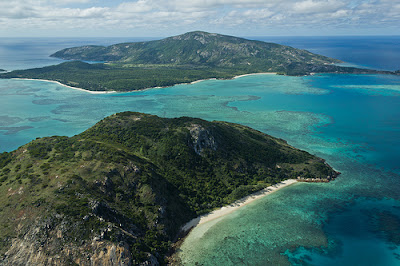
Lizard Island, Australia. Photo: Michael Bok.
In just under a month from now, my lab and I (Ecology of Vision Group) will be flying to Australia, Lizard Island, on a mission to unveil more secrets about the vision of marine animals. You may be wondering why it is necessary to travel across the world to do this. Well, aside from the fact that scientific success increases significantly when in an idyllic location (obviously), we need access to Australia's diverse range of reef dwelling beasties, including the charming octopus and the not so charming mantis shrimp, more likely to rip your hand off than to shake it.

A mantis shrimp (stomatopod).
Photo: web.
Our team have collected all of the gear we will be needing for experiments: LCD screens, perspex tubes, lightbulbs, cameras, 3D glasses and milk. Now, it may sound like we are planning to watch a film, but actually we are going to do some serious and exciting science.

The word that binds our research together is polarization. If my colleagues and I were the mince, polarization would be the egg that binds us together forming the burger (?!) that is our group. Slightly off the beaten (egg) track.

Serious science time:


What is polarization?
Unpolarized light coming from a light source is oscillating at all
possible angles in that plane, however, when it is passed through a
filter (polaroid) it becomes polarized, oscillating only at one angle.
When applied to light, polarization means the direction that the light is oscillating in. If you imagine that you are holding a rope and you shake it up and down, waves form, travelling down its length. You can shake the rope from side to side, or also swirl it round forming a rotating pattern that also travels along the rope. This same idea can be applied to light as it too oscillates as it is travelling along as a wave. Just like the wavelength of light can inform an animal of the colour of something it can see, polarization can also provide additional information as light bounces off different structures or is scattered by particles.

How can an animal detect polarized light? 
We, as humans, know that polarized light exists around us, but unfortunately, without polaroid filters, we cannot see it. Unless of course you are one of the lucky few who have deliberately tried to view strong sources of polarized light such as LCD monitor outputs and are now cursed, forever having a strange yellow bow tie shape appear randomly on the desktop. It's called Haidinger's brush if you fancy having a go yourself. To detect polarized light oscillating at one angle, your photoreceptors must be aligned at that same angle, to absorb the maximum amount of light. If your photoreceptor is, say, 90degrees out compared to the polarized light, then it's not going to absorb very efficiently. This sort of arrangement of photoreceptors where one lies at one angle and a second, connected photoreceptor is lined up perpendicular to it, is very common in invertebrates and is the basis for their polarization vision. Simply put, it allows them to compare the outputs of these two receptors and figure out what angle the light is oscillating at.

Why is polarization vision useful?
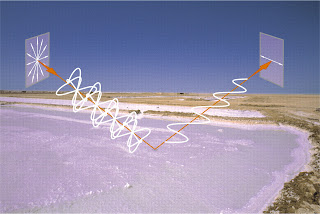
Unpolarized light bouncing off the surface of the
water becoming polarized horizontally.
Photo: Wehner (2001).
At first it might sound like polarization vision could be disadvantageous, since you have the potential to lose information every time polarized light hits your receptors at the wrong angle. What it does do, however, is convey valuable information. When light bounces off a shiny surface, such as water, much of the reflected light becomes horizontally polarized (oscillating at the same angle as the water's surface). If the light hits the water at Brewster's Angle, then all of the light is horizontally polarized. Now, imagine that you are a water-seeking insect where the survival of your species depends on you reaching water to mate and lay your eggs. Some strong selection pressures there. If you have receptors aligned horizontally and pointing down towards the ground, you have a perfect water detecting device. This is a common feature of water-seeking insects. Unfortunately, lots of man-made surfaces are shiny so if you have ever wondered why you find dead beetles and mayflies on the highly reflective bonnet of your car...now you know. Polarization vision isn't just useful for this one task, light is also polarized as it travels through scattering media such as water, or the atmosphere. As the light scatters it becomes polarized at an angle depending on the incident light. If this is happening millions of times in the sky as the light travels towards the Earth, a predictable pattern is formed which acts as a map to navigation and orientation in bees, beetles and other insects where the landscape is complex, moving and changing or devoid of any useful visual landmarks on the ground. The same applies underwater.


Invertebrates such as insects, crabs and cuttlefish have polarization
sensitive cells in the eye consisting of perpendicularly oriented
light absorbing microvilli. You can see the two orientations in the
TEM image of dragonfly photoreceptors above.
Photo: Meyer and Labhart (1993)

I still haven't got to the bit where I explain what we are doing in Australia. I think that is quite enough for one post, time for a cup of tea.


Tuesday, 10 January 2012

Milly: Make some cheese!


I really like cheese.

After some cheese based internet cruising I realised that I could realistically make some myself and so I set forth on a mission to curdle myself a brick of paneer. Since it is easy, cheap and fun (for those who don't get grossed out by things that look like vomit) I have decided to share with you, the joy of curdling.

SCIENCE BIT

Curdling. That thing you accidentally do during cooking when you add cold milk to hot things or when you leave milk in the fridge for so long that it gets a little chunky. Curdling milk is a necessary first step to make all cheeses. It occurs because, on addition of acid (lemon juice, vinegar or from the product of bacteria), the milk coagulates, no longer existing as a nice stable emulsion anymore but separating out into curds (solid) and whey (liquid). When you mix oil and water, an emulsion, eventually the oil will rise to the surface; this is the same with curdling as the more buoyant curds will float up and sit atop the watery whey, hoorwhey! For cheeses that wish to be hard, rennet must be added (extract of calf stomach), forming more cohesive curdling action via the action of enzymes. These cheeses go on to be inoculated with mould and what not but here I will simply demonstrate curdling cow's milk, with lemon juice, to form paneer, a simple cheese used in indian cookery (bit like solidified cottage cheese).

COOKING BIT

Step 1: Heat up a large amount of full fat milk (and only full fat). I used 4 pints. Use a medium heat and keep stirring or it may burn on the bottom (if this happens don't scrape it off, this will make things worse). At this stage you can add herbs/spices if you fancy.


Step 2: Once the milk is properly boiling (before this happens the milk might balloon into a giant dairy cloud so be ready to turn the heat down) add about half a lemon's worth of juice and stir gently. It should start to look disgusting, as shown in the picture. It should progress through the vomit stage (below) and start to look more lumpy, like overcooked scrambled eggs. If this doesn't happen add more lemon juice (shouldn't need more than 1 lemon if using 4 pints). If desired curdling has not been achieved, you may need to start again (this can happen if the milk is not hot enough).


Step 3: Pour the appealing mixture through a piece of muslin (try Kitchens, Whiteladies Road) sat in a colander and give it a rinse with cold water until the mixture is cool enough to handle. Give it a good squeeze to get out excess whey, wrap it up in the cloth tightly and sit a weight on top (big pan with tins in should do it).


Step 4: After about an hour the paneer should be a relatively solid block but it will probably still be quite crumbly.


Step 5: Cook the paneer! I fried mine in some oil to stop it from falling apart when I added it to a curry.


If you fancy a cheap meat alternative or something to make a lovely curry out of have a bash. I like cheese and I hope you do too.

Wednesday, 30 November 2011

Milly: Deep sea flashers


Some brilliant research by Sarah Zylinski that came out of the deep sea research cruise in 2010. Strange to think that even in deep, dark, remote regions, animals still need camouflage...

A link to the paper here.


Sunday, 30 October 2011

Milly: Prepare for the invasion


The undead invade Bristol for the annual zombie walk.
Image: web
Know what to do if zombies attack? Got a plan? I had previously decided that I would break into the Army base on Whiteladies Road and steal a tank but thinking about it, I have a sneaky suspicion that Army bases are locked, with big locks. A fascination with zombie attacks might be disconcerting for some, but seriously, who doesn't get a bit excited about the prospect of giving up all the boring day to day activities for a life of evading the undead, holing up in a creepy lean-to with only beans, spam and warm beer to sustain you? Don't worry though, with so many films, articles, books and even a lecture series at The Zombie Institute for Theoretical Studies available, you can't really go wrong. If you require pointers on how to blend into a gaggle of undead, take part in the annual Bristol zombie walk. Failing that, training is available in the form of a city-wide zombie chase game, 2.8 hours later, allowing us all to get that vital survival experience (possibly the best evening of my life). I did recently realise though, if there are swathes of rotting zombies to run away from most likely many have failed, but then they probably didn't read the guides. You may laugh at the extent of my preparatory measures safe in the knowledge that zombie-creating viruses don't exist but, I hear, the people are tinkering. Apparently there is an alarming increase in the number of amateur scientists trying their hand at genetic modification in the kitchen. With such a wealth of information available online, it may just be a matter of time until someone makes a terrible blunder, or perhaps the product of a crazy horror film enthusiast leads to the genesis of a deadly virus that reanimates the dead. If not, sounds like an excellent start to a zombie film. I've got my shotgun polished and my fingers crossed...


Saturday, 27 August 2011

Milly: Ugly Fish pt 9


Milly: Ugly Fish pt 8

"Here you are" said Alan, all blasé, as he passed me something he had picked out of the trawl net. It looked like a dead hand on the end of a stick and smelt like one too; I didn't have a clue what I was looking at. The more learned scientists told me it was a stalked crinoid, a sea lilly, part of the Phylum Echinodermata, so related to starfish, sea cucumbers and sea urchins. As I looked closer I realised that it was much more attractive than a decomposing fist, with many intricate feathery arms that I imagined would actually look quite nice when underwater.


Having a gander at the feeding arms of the crinoid, note the long
stalk in the background, these can be 1 metre long! Image: Zan
Close up of the main body of the crinoid
showing the stem leading to the calyx
and then the feeding arms at the end.
Image: Zan

Another species of deep-sea stalked crinoid called Moulin Rouge
(Proisocrinus ruberrimus) photographed on the sea floor. Pretty sexy, for a crinoid.
Image: National History Museum

These fascinating creatures look like plants (hence the name 'sea lily') but have the features of animals such as a basic gut, a simple nervous system and a fully functional circulatory system that transports nutrients, gases and waste products around the body. The many feathery arms found near the mouth (and also unfortunately the anus) are used to filter out small particles in the water where it is trapped in sticky secreted mucus and pushed into the mouth.

They are sometimes referred to as 'living fossils' as they seem to remain relatively unchanged morphologically since their radiation during the Paleozoic Era (about 550-250 million years ago).

A fossil stalked crinoid,
looks a lot like the modern version.
Image: web
Shallow water crinoids are often free-swimming, and crinoids with long stalks, such as the one from our trawl, are usually found at depth, anchored to the ocean floor (ours was found at about 4500m). I say anchored...but scientists recently observed sea lilies up-rooting and crawling along the sediment, seems there is yet more to be discovered about these strange animals....

Saturday, 20 August 2011

Milly: Ugly Fish pt 8

Milly: Ugly Fish pt 1
Milly: Ugly Fish pt 2
Milly: Ugly Fish pt 3
Milly: Ugly Fish pt 4
Milly: Ugly Fish pt 5
Milly: Ugly Fish pt 6
Milly: Ugly Fish pt 7

Coming back to my post about pressure (pt 6), how are deep sea animals adapted to survive at depth?

As there are all sorts of animals currently inhabiting the deep, I'll concentrate on fish. Fish are the best anyway. Slightly biased.

Well the problem is, fish don't just have to cope with the crushing pressure (up to 800x greater than at the surface) but the deep is also very dark (beyond 1000m there is negligible surface light) and cold (2°C) making things such as moving around, finding food and reproducing much more challenging. Let's have a look at a few fish and see how they do it. Enter handsome fellow number one, the anglerfish.


Whipnose anglerfish, about the size of a football.
Note the long lure with the tiny esca on the end, capable of bioluminescing.
Image: Dianne Bray
A selection of anglers.
Image: Dr Theodore W. Pietsch and Christopher P. Kenaley

There are 11 families of deep sea anglerfish, some only containing one species, such as the lonely prickly seadevilCentrophryne spinulosa (Centrophrynidae family) others have many more such as the footballfishHimantolophidae with 19 species. They are a surprisingly diverse group of ugly fish. As you can see from the pictures above, these animals don't look particularly athletic. If you were to design an animal for a race underwater I doubt 'round' would be the shape you would go for. Nevertheless, these are very successful bathypelagic (1000 - 4000m) animals, but why? Anglerfish are sit and wait predators and with the aid of their bioluminescent lure, can draw in prey such as fish and cephalopods (squid etc) within gobbling distance. The bioluminescent light, which can be controlled producing flashes or sustained glowing is the product of many bioluminescent bacteria that colonise the lure (or esca). They don't even need to feed particularly often since they expend such little energy, evident when you touch one of these animals. Their bodies are both flabby and bony (an attractive combination) suggesting they do very little excercise. Lazy little anglerfish. Not only are they lazy but seriously greedy. An expandable stomach allows anglerfish to munch down prey twice their size. A human man could fulfil his daily allowance of calories with 850g of meat, less than the weight of a mature trout! Seriously rubbish in comparison. 


Sea devil (Melanocetus niger), about the size of a
golf ball, look at that mouth! Image: Milly Sharkey


A female angler with the tiny parasitic male attached.
Image: Dr Theodore W. Pietsch. University of Washington
One problem that could arise, being a voracious predator in the dark munching on anything that moves, is that you might accidentally eat your mate. Finding a mate in the dark expanse of the deep sea is likely to be a very rare event. Some anglers have evolved a bizarre strategy whereby the male does not develop fully, is unable to feed properly and has enhanced olfactory senses (smell). This spurs the male on to quickly find a female before he starves, detecting the pheromones she expels into the water. When they do meet, the male bites the female, releasing enzymes that break down the skin between them, causing the two to fuse. The lucky male is now parasitic and no longer requires digestive organs, brain or his own heart (I told you they were lazy), obtaining everything he needs from the female. In return, he provides her with sperm from his last remaining organ, his gonads, a perfect relationship some may say. Bit clingy, plus he's a bit screwed...sorry I'll stop now.

More later, I need to locate pre-trawl pudding.


Tuesday, 16 August 2011

Milly: Ugly Fish pt 7


Milly: Ugly Fish pt 1
Milly: Ugly Fish pt 2
Milly: Ugly Fish pt 3
Milly: Ugly Fish pt 4
Milly: Ugly Fish pt 5
Milly: Ugly Fish pt 6

Always dark on the night shift... Image: web
Prepare to commence trawl two. When you have been on a night shift from 4pm to 4am and a trawl is due to hit the deck at 2am, chances are your body clock is going to be a tad confused. Last time I nearly fell asleep in my fish dissection, started writing backwards and couldn’t retain a two digit number in my head for more than 1millisecond. Not doing that again. New tactic! Since I had allocated rest time before the trawl... I decided to stay awake for 28 hours before the trawl, have a sleep then be all fresh and ready for action once the slimy catch was brought aboard. Problem with that is staying awake for 28 hours with absolutely nothing to do tends to send you a bit West. I became inaudible, talking at extremely low baritone frequencies if you can even call it talking, more like incoherent blatherings. The day shift tolerated me well. The rewards were great however, and this time, we were super fish team extraordinaire (well, we functioned without any breakdowns anyhow).


Much like last time, the trawl net was opened (noticeably more rotund this time, a good sign) and catch was spilled into a large bucket ready for inspection. Unfortunately on the last trawl we managed to scoop up a large amount of clinker (burnt coal from steam ships of the past) which made sorting through the cucumbers and delicately removing gelatinous fish nigh impossible. This time, we had little ocean floor debris so I zealously sunk my arms into the cold, slippery assortment of fish, cucumbers and crustaceans and pulled out a big, heavy object. “Oh wow, an exciting find" I thought to myself. “Doesn’t feel like a cucumber, maybe it is a big leathery fish, woohoo!" It was a shoe, a big, woman’s boot. I then proceeded to dig out two bottles and a rock. Thankfully Alan and Juliette were being slightly more sensible and actually searching for fish shaped objects and so commenced a slithery extraction of rattails, smooth-heads, some unfortunate midwater fish and a huge cusk-eel.


Is it a fish?! Is it a holothuriuan?! No. It's a bloody shoe.

Histiobranchus sp., a deep sea eel. Image: Zan 
Cusk-eel! Image: Zan 
 Lovely cusk-eel (Ophidiid). Image: Nina

We had fewer fish this time round, but they were all in really great condition, great for samples we thought, but then memories of hours in the dark surfaced in my brain and I realised that watching 3 horror films to try and stay awake was, perhaps, a terrible idea. Juliette and I managed to put aside a few minutes whilst our fish eyes were on ice to explore the trawl and the sorting process in the wet lab. It looked how I would imagine a backstreet fishmongers from a sci-fi film to look. All manner of strange beasts being weighed and measured and samples for DNA analysis being taken left right and centre. The fish were amazing. There was one fish, aptly named ‘Jellyface’ by Zan, which had a large rounded nose, a small mouth and two, what looked like sensory pits, next to the eyes. The skin on the head felt very bizarre, much like a stubbly beard. The cusk-eel felt even stranger, as you ran your fingers across its skin you felt a crackling sensation which could be due to tiny bubbles under the skin forming as the fish is brought up from depth, decompressing the air within its cells. 


'Jellyface'. Image: Zan


Juliette having a good rummage around in the cucumbers. Image: Nina
Not the most attractive of creatures.
According to one scientist this cucumber is "cute", "look at it's little hat!" she said. I later discovered this 'little hat' is in fact a parasitic anemone. The deep sea is a very strange place! Image: Nina

I had been challenged by one of my supervisors to kiss a benthic fish. Now, he may well have been joking, but I considered this something I should take very seriously and so I sought out the loveliest of all the fish in the catch, the cusk-eel and planted my lips firmly upon its slimy....mouthparts. Picture taken. Job done.

I think the picture says it all. Image: Nina

So why is all of this necessary? Larking about aside, we are taking samples for serious and important science and all possible information is always gathered from these trawls, to make the most of each catch. Stay tuned for
 an explanation of the science behind the sampling, most likely in the form of an interview with Juliette McGregor (she doesn't know this yet). Roll on the final trawl. Fingers crossed my supervisor doesn’t up the stakes, kissing a benthic fish is one thing, but kissing a sea cucumber, well that's a whole different level of gross.

Sunday, 14 August 2011

Milly: Ugly Fish Pt 6

Deep sea Marmite from 7000m
Milly: Ugly Fish pt 1
Milly: Ugly Fish pt 7

Life on board a research ship can, at times, be rather boring. It is imperative that, to stave off derangement, you make your own fun preferably without damaging yourself or others. We have had a few ideas, after a particularly uneventful evening of mud measuring: 1) Deep sea fish top trumps 2) a horror film featuring a radioactive or chemical spill creating GIANT holuthorians, I'd quite like to call it 'Horrorthurian', not a catchy title and 3) sending weird objects to the ocean floor to see what happens to them.

During my last research cruise Alan very kindly allowed me to place a jar of marmite atop his lander and send it down into the Peru-Chile trench (7000-8000m). Sealed with a plastic top, the marmite was put under an enormous amount of pressure and subsequently its consistency was altered rather dramatically. The top layer became runny like water and at the bottom, set like concrete. I had a great deal of fun digging around in my marmite jar for hours trying to stir it all up whilst an American scientist looked on, grimacing every once in a while when he caught a whiff of its beefy goodness.

So, what does happen to things when they go down the the bottom of the ocean? Well, have a look at this polystyrene cup I put down to 4800m strapped to the lander below. Unfortunately for me, Alan, at 5am, thought it would be really funny if he put it into the bag he had been storing his bait in, before sending it down into the abyss. The reason my cup is now the size of a thimble (and strangely distorted) is due to the effect pressure has on air. Inside the polystyrene lies little air pockets that get compressed with depth, as the pressure increases. The cup is, of course, now also impregnated with mackerel juice, thank you Alan.


My polystyrene cup (left) looking rather distorted and how it looked
 before compression (right)

A previous effort...much better!
Getting slightly more creative....OCUPTOPUS!
Rather boring 'science' bit:

Pressure is measured in pascals (Pa) which corresponds to one newton per square meter (imagine one newton force as the force of the Earth's gravity on an apple). 100kPa (100,000 Pa) is typical air pressure at the surface of the Earth. With every 10m that the cup descends, another 100kPa of pressure is added, constantly squeezing the air into a smaller area until it reaches a point where most of the air is squeezed out of the cup entirely. I've been asked by an alarming number of people whether I will be doing any deep sea diving on this trip. Unfortunately, much like the cup, the air in my lungs would be squeezed out and although this can be rectified by using pressurised air (as with SCUBA diving) to fill up my lungs again, after about 60m the oxygen in the air at high partial pressure would start to poison me, forming reactive species, damaging my cells. Commercial divers are able to reach depths of 100m using gas mixtures with snazzy names like 'hydreliox' (helium, hydrogen and oxygen) or 'neox' (neon and oxygen) which have reduced levels of oxygen and are therefore less likely to cause damage. I say less because there is still the risk of inert gas bubbles forming in the blood or tissues of a diver as they ascend from depth, 'the bends'. It has also been pointed out to me that in carrying enough air for such a trip, I would be squashed like a ripe pear.

At 100m there is 1100kPa of pressure. The deepest living fish ever recorded were at 7.7km (Alan Jamieson, again) where pressure is about 77,500kPa! So how do they survive at these depths under extreme pressure?


I shall explain all in a future post...there is a trawl afoot.

Thursday, 11 August 2011

Milly: Ugly Fish Pt 5

Alan with his lander 'Dave', about to be deployed
over the back of the ship. Image: Nina
Milly: Ugly Fish Pt 1
Milly: Ugly Fish Pt 2
Milly: Ugly Fish Pt 3
Milly: Ugly Fish Pt 4
Milly: Ugly Fish Pt 6
Milly: Ugly Fish Pt 7

Things have been relatively quiet over the last few days. No riots here, just high base levels of madness, but then you have to be slightly weird to want to go on a research ship for half of your summer. A few of us have put our heads together and have come up with some ideas for thwarting the violence. We propose the development of a porridge cannon firing hot, sloppy, honey saturated oats. "You would have to counter it with milk and sugar" said one scientist, "they wouldn't expect that". I'm not here to comment on the riots, nor should I make light of the situation but it is very odd reading the updates from sea, it all feels very unreal.

"What exciting thing have you discovered today?!" I imagine my supervisor will be thinking. Well Julian, personally absolutely nothing. I got up, went to the gym then ate a giant plate of shepherds pie and cabbage for breakfast. Proper scientists however have been discovering some really amazing stuff.

Alan Jamieson from Oceanlab, Aberdeen, has sent his lander 'Dave' to the sea floor to photograph the mud (mud again), haha only joking, to photograph the animals! Sorry mud scientists but I've had quite enough of your mud for the time being, especially when there are ugly fish to be photographed!


An Ophidiid, Bassozetus sp., a cusk-eel. Image: Alan Jamieson
An abyssal grenadier (Coryphaenoides armatus) looking rather sad. It must be hard being a deep sea fish.
Image: Alan Jamieson

Nine abyssal grenadiers at the bait. Image: Alan Jamieson
The lander is essentially a large aluminium frame with a number of cameras attached to it, a giant flash and a weight with bait attached to it (more stinking mackerel). It gets sent to the bottom and (hopefully) paparazzis all of the beasties who come to dine at Alan's table. Whilst it may seem relatively easy to chuck a piece of kit over the side to sink to the bottom of the ocean, getting it back is a complicated process. And actually there is no 'chucking' involved, but careful winching and manoeuvring to ensure the lander doesn't get destroyed by the ship's propeller.

To get Dave back (and all of the photos) an acoustic signal is sent from the ship into the water where it travels down to Dave and triggers the release of it's (his?) weights via the movement of mechanical arms. Dave then floats up to the surface powered by the buoyancy of the glass floats attached, where he is collected by the ship! Phew. How on earth this signal manages to travel from the boat all the way to the bottom of the ocean, intact, is beyond me. Mysterious wizardry.

Trawl on Saturday morning, really hope we catch this fella, Bassozetus compressus, the abyssal assfish. Excellent.

Tuesday, 9 August 2011

Milly: Ugly Fish pt 4

Milly: Ugly Fish pt 1
Milly: Ugly Fish pt 2
Milly: Ugly Fish pt 3
Milly: Ugly Fish pt 5
Milly: Ugly Fish Pt 6
Milly: Ugly Fish Pt 7


Juliette and I digging about in the catch
UGLY FISH! Finally, we have a trawl! Never have I seen so many bizarre looking animals (presuming things that freakish are allowed to be classified as animals) in one place before. Once the catch was hauled on board at about 8am, safely away from the stern that was flying in the air due to the brilliantly timed bad weather, Juliette and I got the first look in (we needed to get fish into the dark asap). That lasted a matter of minutes as a riot from the sidelines began to brew. Reluctantly we brought the catch into the hangar and the feeding frenzy commenced. All scientists descended, franticly digging around in the clinker (burnt coal from back when we had steam ships) pulling out sea cucumbers the size of, well, cucumbers which, in my opinion, fell into three categories. They either looked like bloated sausages, huge purple tongues or like something from the ‘extreme’ section of Anne Summers.


Quickly trying to whisk the fish away before they get exposed
to too much light
A fangtooth, wouldn't call this fish ugly to its face
A bizzarre collection of sea cucumbers.

Scientists went into warp drive, taxonomists started identifying the hundreds of deep sea creatures, geneticists took samples from everything that and one girl Zan after weighing and measuring the fish was even examining their stomach contents. Wonderful, organised chaos.


Sorting through the cucumbers


Looks like a rather disturbing picnic spread.

One of the many crustaceans
that came up with the trawl

Selection of grenadiers

An assortment of slickheads

So in the midst of all of the excitement what were Juliette and I doing? Oh, that’s right, we were barricaded in a blacked out lab with only dim red light to guide us and each other (plus a bag of fish) for company. Since we were under time constraints to get the eyes out of the fish as soon as physically possible I grabbed the first fish out of the bag (an extraordinarily disgusting place to put your hand into, I might add) whacked it on the scales and began the first dissection. Glancing over at Juliette I was slightly worried she might have had a melt down. After the weeks of careful planning and packing, she was finally about to begin the first sample collection, in the dark, likely to take about 12 hours and her legs and arms had frozen in place. Thankfully, the roll of the ship prevented any stationary activity and team fish were off.

With every hesitant poke around in the fish bag, came more gelatinous, benthic beasties. 

About 10 hours later, sleep deprived (after switching from the night shift), stinking of fish, cross eyed and suffering from tunnel vision, Juliette and I emerged triumphant. All fish processed, retinal tissue dissected and placed carefully into various fixes to preserve cells or RNA/DNA.

Apparently there will be another trawl on Friday. God help us.

Thanks Nina and Zan for the pictures!
Success! Sleep deprivation and a very wet arse.