Showing posts with label bristol. Show all posts

Saturday, 28 April 2012

Angel:Mexico Day at the University of Bristol 30/04/12


I've just got this email few days ago regarding the Mexico Day at UoB next Monday, which maybe could be interesting for some of you. This special event is not only an opportunity to hear the Mexican Embassador, Eduardo Medina-Mora Icaza, besides the audience will have the chance to look over some posters on currently research projects concerning Mexico:


I'm pleased to announce that next Monday 30th April will be Mexico Day at the University of Bristol. We would like to invite you to a special event to celebrate the University of Bristol's links with Mexico.

Bristol is proud to host the Mexican Ambassador, Eduardo Medina-Mora Icaza, for the day and he'll be giving a question-and-answer session for all interested students and staff.

It will be running from 3 o'clock in the Seminar Room of the Nanoscience Building on Tyndall Avenue. The hour-long session will be a rare opportunity to put your questions to the ambassador.

This event will be free of charge and we hope you will be able to attend.

Following the Q&A the Ambassador will be introducing a special lecture 'Rethinking Nineteenth-century Mexico: Following in the steps of Professor Michael P. Costeloe' by Bristol alumnus Professor Will Fowler of St Andrews. This will culminate with a wine reception. Please see here for details.

For directions to the Nanoscience building please see here.

The Faculty of Science can't be out of this special event, Marisol Correa, a current PhD student in the School of Chemistry under the supervision of Professor Richard Evershed, is conducting a research project about absorbed organic residues analysis from utilitarian ‘cooking’ pottery in Mexico. The analysis of organic residues has been a successful tool in order to answer archaeological  questions relating to ancient diet and agriculture in other parts of the world. Besides, the outcome from this project would be useful to achieve a better knowledge of social patterns such as strategies of land use in the urban hinterland.

Trajineras, colorful gondolas - Xochimilco, Mexico, 2011

Tuesday, 22 November 2011

Sir Paul Nurse and Poetry

Photo: Royal Society
There were two great events held here in Bristol last night, one at the University and one at the Bristol Old Vic, and I was hoping against hope that I would find a connection between them to make this blog post flow! And... what do you know? I did. The first was Sir Paul Nurse, president of the Royal Society, Nobel Prize winner, geneticist, president of Rockefeller University New York... all-round very very interesting scientist and excellent talker-about-science! He was giving the Sir Anthony Epstein lecture at the Wills Tower, in the largest, cathedral-like space, which was packed to the rafters... His topic was "Great Ideas in Biology" and he was quick to point out that these weren't THE great ideas in biology but his pick of great ideas... although he felt that most people would agree on 4 out of the 5.

So, what were his great ideas? Well: The Cell, The Gene, Evolution by Natural Selection, Life as Chemistry (and Physics) and the fifth, possibly contentious one, Biology as an Organized System, by which he meant looking at the biological networks and how they are structured, looking at the flow of "information", at the system as an information carrier.

It was all fascinating stuff, some of which I already knew a bit of, but always good to be reminded what a chromosome is, for example... with some great slides and historical perspective! I was then heading to a poetry event, so, I hear you ask, how are the two connected?? Well, it was at Great Idea Number 3, which you would assume centred around one Charles Darwin. But no, in fact Sir Paul wanted to focus on Charles' grandad, Erasmus, who was the first to talk about evolution (Charles later supplied the vast quantities of data to prove it). Not only that, apparently Erasmus - who was a colourful figure, so large that he cut an oval out of his dining table so he might sit rather nearer to his supper, and fathered 14 children - was a poet, at one time "one of the best known poets in England"! And not only that, he wrote much of his scientific reports in blank verse! (See Jenny Uglow on Erasmus Darwin's poetry in The Guardian). The Poetry Foundation gives us his poem, The Botanic Garden, and here is an excerpt:
 “You taught mysterious Bacon to explore
Metallic veins, and part the dross from ore;
With sylvan coal in whirling mills combine
The crystal’d nitre, and the sulphurous mine;
Through wiry nets the black diffusion strain,
And close an airy ocean in a grain.—
Pent in dark chambers of cylindric brass,
Slumbers in grim repose the sooty mass;
Lit by the brilliant spark, from grain to grain
Runs the quick fire along the kindling train;
On the pain’d ear-drum bursts the sudden crash
Starts the red-flame, and death pursues the flash.—
Fear’s feeble hand directs the fiery darts,
And strength and courage yield to chemic arts;
Guilt with pale brow the mimic thunder owns,
And tyrants tremble on their blood-stain’d thrones.

Stirring stuff! Now the poets I went to see after this lecture, Luke Kennard and Tom Philips,  did not deal directly with biology but I feel that Erasmus D would have enjoyed the evening, which moved from a searing critique/love poem about Portishead to a tale of the Murderer being taken for a haircut. I was immensely impressed by the whole event, organised monthly by Word of Mouth -  highly recommended if you are in the vicinity!

So, an evening of poetry, biology and biological poetry, what more could I have wanted?

Sunday, 30 October 2011

Milly: Prepare for the invasion


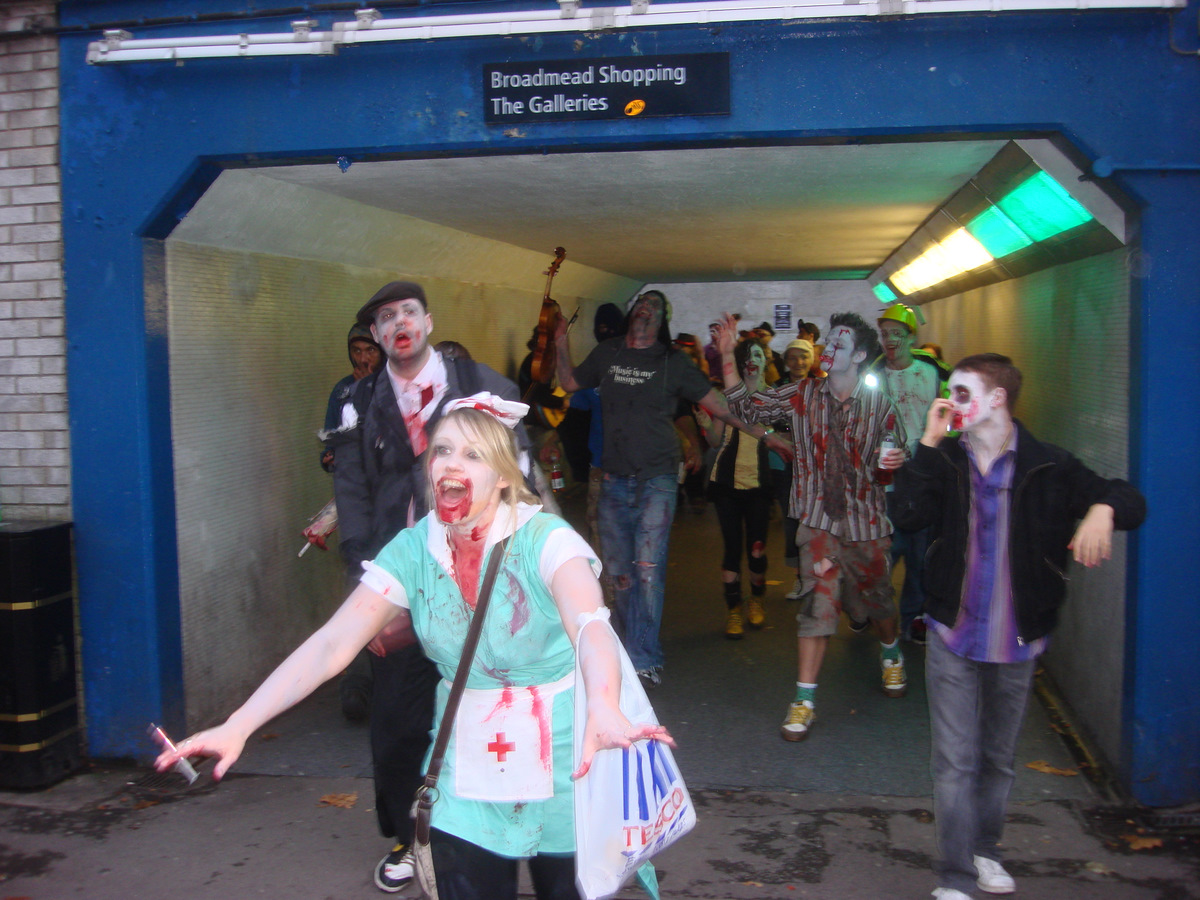
The undead invade Bristol for the annual zombie walk.
Image: web
Know what to do if zombies attack? Got a plan? I had previously decided that I would break into the Army base on Whiteladies Road and steal a tank but thinking about it, I have a sneaky suspicion that Army bases are locked, with big locks. A fascination with zombie attacks might be disconcerting for some, but seriously, who doesn't get a bit excited about the prospect of giving up all the boring day to day activities for a life of evading the undead, holing up in a creepy lean-to with only beans, spam and warm beer to sustain you? Don't worry though, with so many films, articles, books and even a lecture series at The Zombie Institute for Theoretical Studies available, you can't really go wrong. If you require pointers on how to blend into a gaggle of undead, take part in the annual Bristol zombie walk. Failing that, training is available in the form of a city-wide zombie chase game, 2.8 hours later, allowing us all to get that vital survival experience (possibly the best evening of my life). I did recently realise though, if there are swathes of rotting zombies to run away from most likely many have failed, but then they probably didn't read the guides. You may laugh at the extent of my preparatory measures safe in the knowledge that zombie-creating viruses don't exist but, I hear, the people are tinkering. Apparently there is an alarming increase in the number of amateur scientists trying their hand at genetic modification in the kitchen. With such a wealth of information available online, it may just be a matter of time until someone makes a terrible blunder, or perhaps the product of a crazy horror film enthusiast leads to the genesis of a deadly virus that reanimates the dead. If not, sounds like an excellent start to a zombie film. I've got my shotgun polished and my fingers crossed...